Here is something strange about your coffee. Caffeine is not the thing that wakes you up.
Caffeine is the package. Your liver opens it, breaks it into three smaller molecules, and those molecules do the work. Two of them are great. One of them is an asthma drug.
So we stopped sending the package.
Short answer: your liver splits caffeine into paraxanthine, theobromine and theophylline. Paraxanthine is the sharp part. Theobromine is the smooth part. Godspeed delivers those two directly, as a pair, leaves the third out, and adds a fuel caffeine can never give you: ketones.
What caffeine actually breaks down into
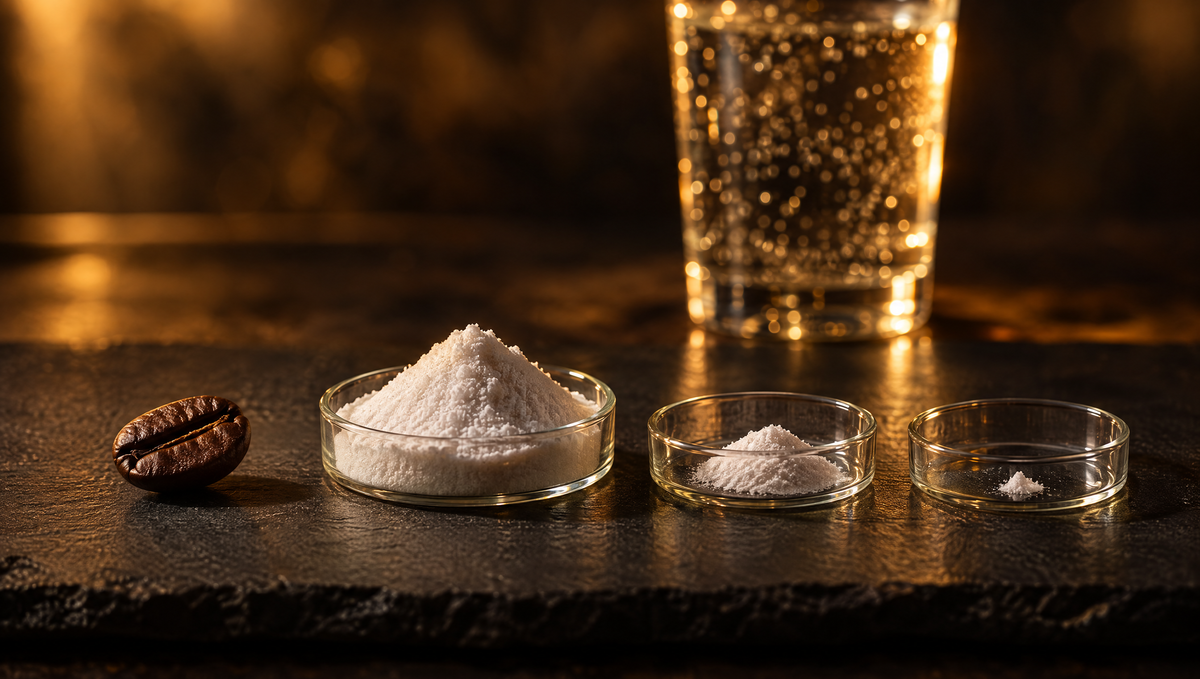
Within an hour or two of your first sip, a liver enzyme called CYP1A2 pulls caffeine apart. The split is lopsided.
| Metabolite | Share of the caffeine | What it does |
|---|---|---|
| Paraxanthine | About 84% | Blocks adenosine. Focus and alertness. |
| Theobromine | About 12% | Mild, long, widens blood vessels. |
| Theophylline | About 4% | Relaxes airways. A prescription asthma drug. |
Read that again. Every cup of coffee you have ever had was mostly a paraxanthine delivery with a jittery front end and a long wait on your liver.
And how fast your liver does the job is written in your genes. Fast metabolizers feel coffee come and go. Slow metabolizers carry it around all day. That is where the 3pm heart rate and the 11pm ceiling stare come from. Same cup. Different person.
Paraxanthine, the sharp part
Paraxanthine is the part of caffeine that does the thing you drink coffee for. It blocks adenosine, the molecule that stacks up all day and makes you feel tired, and it clears out faster than caffeine does.
It has been tested on its own. In a double-blind, placebo-controlled crossover trial published in Nutrients in 2021, paraxanthine beat placebo on short-term memory, reasoning, response time and sustained attention.
Fast on. Clean off. Godspeed carries 102 mg as enfinity, a purified form.
Theobromine, the smooth part
Theobromine is why dark chocolate feels the way it does. Mild stimulant, long gentle curve, almost no edge.
And it runs the opposite direction from caffeine on your blood vessels. Caffeine tightens them. Theobromine widens them, which supports healthy blood flow and is a big part of why it never feels like a spike. Godspeed carries 102 mg, sourced from cacao.
Why the two together beat either one alone
Coffee gives you both. On your liver's schedule, in a line, with caffeine standing out front.
Deliver them directly and you get to shape the curve. Paraxanthine brings the lift fast and leaves before it can keep you up. Theobromine slides in underneath it, slower and longer, and carries the back half of the day.
One opens the throttle. The other holds it steady.
Same two molecules your body was always going to make. They just show up together instead of standing in line, with nothing in front of them.
Theophylline, the part we leave out
Theophylline relaxes the smooth muscle in your airways. It is a prescription asthma medication. It is not an energy molecule, and nobody picks it off a shelf for focus.
Coffee hands it to you anyway. Godspeed does not. We are not building a coffee. We are building the part of coffee that works.
Now the part caffeine cannot do
Stimulants do not make energy. They block the signal telling you to stop. That is useful, and it is also exactly why a stimulant on its own ends in a crash. The adenosine never left. It was piling up behind the door the whole time.
So the third thing in Godspeed is not a stimulant at all. It is fuel.
Beta-hydroxybutyrate, BHB, is a ketone your cells burn in the mitochondria to make ATP. It crosses into the brain and it does not need a sugar spike to get there. One stick carries 6 or more grams of goBHB bound to the electrolytes you sweat out.
Paraxanthine and theobromine open the door. Ketones are what walks through it.
What it feels like
It comes on inside the first hour. Clear, not wired. No 3pm trapdoor.
Most people describe it as the second cup of coffee without the first.
FAQ
What does caffeine break down into?
The liver enzyme CYP1A2 metabolizes caffeine into three compounds: paraxanthine, about 84 percent, theobromine, about 12 percent, and theophylline, about 4 percent. Paraxanthine drives most of the alertness you feel from coffee.
Does Godspeed have caffeine?
No added caffeine. It carries paraxanthine and theobromine, two of caffeine's three metabolites, delivered directly.
Is paraxanthine stronger than caffeine?
Milligram for milligram it is comparable for alertness in the published trial, with a shorter half life. People tend to describe it as cleaner, not stronger.
Why pair paraxanthine with theobromine?
Paraxanthine is fast and short. Theobromine is slow and long, and widens blood vessels instead of tightening them. Together they cover the front and the back of the day without a spike.
Can I drink coffee with Godspeed?
You can. Start with one stick and your usual coffee and see how you feel. Most people find they want less coffee.
Sources
- Caffeine metabolism by CYP1A2 into paraxanthine (84%), theobromine (12%) and theophylline (4%): standard pharmacology references.
- Yoo C et al. Acute paraxanthine ingestion improves cognition and short-term memory and helps sustain attention in a double-blind, placebo-controlled, crossover trial. Nutrients. 2021;13(11):3980.
- Theobromine as a vasodilator: standard pharmacology references.
- Ketone body oxidation and blood-brain barrier transport: standard biochemistry references.